

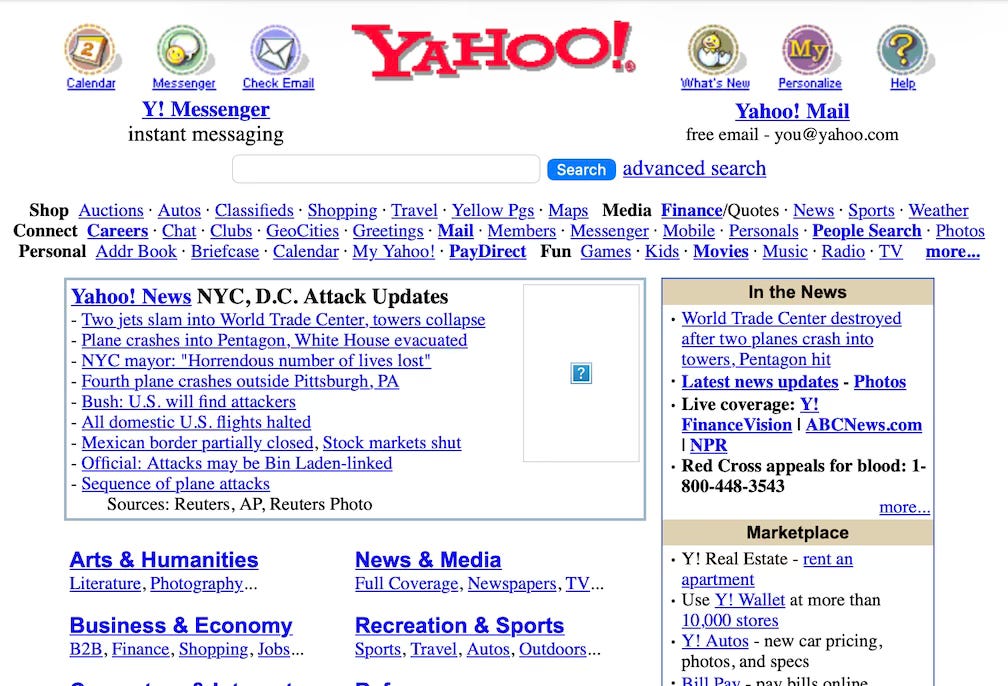
This is a memory — one person’s lens on a day the world will never forget.
The pager buzzed at 5:53 a.m.
It was on my nightstand, rattling across the wood before I grabbed it and flipped open the little plastic door to show the single line of gray text on a lime green teletype screen. It told me what was happening.
“AP NewsAlert—Plane crashes into World Trade Center, according to television reports.”
When I started my new job in March 2001 as an associate producer at Yahoo! News, they handed me that pager “in case something happens in the news and you need to go to work.”
Pagers were more common at the time for doctors, lawyers, maybe civil servants, and nobody I knew was that clear why I’d need one. My friends and family looked at the thing clipped to my belt with curious glances. My dad, himself a practiced pager wearer, asked me about the pay protocol—did I get double or triple time pay whenever I responded to a page like he did.
“Nope,” I remember telling him. “Some news happens, they page you about it, and you go to work.”
Charlene was already up early to staff a telephone press interview for Cisco. She’d gotten the Trade Center news from a colleague on the call and turned the television on. Charlene’s team had traveled to Atlanta for a trade show, but she was five and a half months pregnant with our first child, so she stayed home.
Charlene told me what was happening, and I showed her my pager. I sat down in the kitchen and used our modem — a few beats of booping and screeching — to connect my work laptop to the Internet and check in. Co-workers were already online working and heading into the office. (Our Yahoo! News team used Yahoo! Messenger to communicate.)
Charlene and I rushed to get ready with the TV on in the background. CNN had already cut into normal programming — the anchors were trying to make sense of what was happening. Back then CNN was cable news; Fox was a much smaller upstart, MSNBC was even smaller. We flipped through the dials to see — NBC, CBS and ABC all broke into coverage interrupting the usual rhythm of their morning talk shows.
American Flight 11 had hit the Trade Center North Tower. Then at 6:03 a.m. our time, United Flight 175 hit the South Tower. CNN showed taped footage of President Bush being told what was happening while he listened to grade school kids reading aloud in a Florida classroom. They were reading The Pet Goat.
Charlene and I headed into work early. Traffic was strangely normal as we drove south on 101 in our 1995 Honda Civic, listening to NPR, trying to keep up.
As we headed to Yahoo!’s campus to drop me off, NPR reported that Flight 77 had hit the Pentagon. Minutes later, the FAA grounded all flights nationwide, something that had never happened before. We heard the White House and U.S. Capitol were being evacuated.
It was 6:48 a.m. The sun was just rising over the Bay Area, obscured by the morning’s gray marine layer.
The pager rattled all morning with more AP and Reuters alerts. FBI investigating reports of hijacking; car bomb explodes outside the State Department (later retracted); large plane down in Pennsylvania; markets suspended.
AP has something called a flash, the wire’s rarest designation, saved for assassinations or moon landings. On 9/11, AP issued two: one for each tower coming down. Both of those arrived shortly after 7 a.m. on the West Coast.
I remember walking into our Yahoo! News cubicles on the second floor of Building B at the company’s gray-and-purple campus in Sunnyvale. The newsroom of the world’s largest news site was a few rows of understated office cubicles in yellow and purple. This was where Yahoo!’s news and media products were built.
Yahoo! News had maybe 15 people working on the news site directly: Engineers, Producers (a role that evolved into Product Managers), Designers, Business Development, and Ad Sales plus the company’s “Full Coverage” editors who hand-edited pages aggregating the most useful links on any topic. Those links, which also showed up alongside many news stories, deliberately pointed users off Yahoo! to the best coverage anywhere. No one else online did that at the time.
There were no reporters on this team. Yahoo! News was aggregation—headlines, photos, and videos from other news brands, all presented together on simple white HTML pages with the original red Yahoo! logo. It was a new way of conceiving of what online news could even be. A media company, but different.
There was a hum of activity in an otherwise quiet office that morning as we dealt with the unprecedented crush of web traffic. We worked to curate and assemble the site’s coverage of an event none of us had ever seen anything like before.
I remember Tony Tam, our lead software engineer, on a conference call working with Yahoo! co-founder David Filo and others to spin up servers from other parts of the company to handle all the news traffic. They stripped the site down to make sure it would load.
Websites for CNN, MSNBC, the New York Times, ABC, and the Washington Post were unreachable at points during the morning as users from around the world overwhelmed servers seeking the latest information. Yahoo! News held up because of its lean, well-written software and light, simple web pages built to load in browsers quickly.
Our GM, Chris McGill, was on the phone discussing whether to pull down the site’s banner ads so pages could load faster—and so readers wouldn’t see ads alongside what were becoming increasingly disturbing stories and images. We did pull ads down for a time. We decided to show every photo that AP gave us, keeping the most disturbing images off of Yahoo.com.
Producers Ron Parsons, Kourosh Karimkhany, and I were making sure news feeds were coming in, deciding which wire services to feature, assembling photo slideshows from material coming in from the scenes, and getting links to video clips into as many stories as possible. There were lots of coordinating calls and troubleshooting with the AP and Reuters news desks. We worked with ABC News to get a live video feed up. For a while that feed only ran on Yahoo! News while ABC News’ own site was down.
The Full Coverage editors—Brad Rubin, John Briggs, Kevin Mooney, Molly McCall, and others—were building coverage pages and working with Yahoo!’s homepage team to take over the top of the page to hand-edit links to stories, photos, and video in a news box built on the fly. The team also added the phone number people could call to donate blood to the Red Cross.
About half of American adults were online, and only 1 in 10 US homes had broadband. Since many workplaces had faster T1 lines (fiber came later), the office desktop web browser—plus television or radio if you could get it at work—was how the world took in the news.
There was occasional chatter as we coordinated or stopped to gasp together at the magnitude of the latest news. We had a couple of TVs with constant live coverage, one mounted on the wall and another propped up on a cubicle. The Sports guys nearby donated their TV to us so we could see it from our cubes while we worked. They wouldn’t be needing it.
There were no smartphones, and no App Store. The iPhone was still six years away. Facebook, YouTube, Instagram, and Twitter didn’t yet exist.
Google was a three-year-old search engine then, and search was the entire company—no news product at all. It famously resorted to putting a text message on its home page telling people to turn on their TV or go to news sites.
In the Yahoo! News room, we were all on autopilot, far removed from the East Coast. The work meant being immersed in the news in real time as it came in. It was a mix of adrenaline and action, with in-between moments of shock.
And whatever we felt that day was nothing compared to what the day actually was: nearly 3,000 people did not come home. The work was meaningful—easily among the most meaningful work I’ve ever done. Some of the coverage survives—in the Wayback Machine, and in the Library of Congress’s September 11 web archive.
I stayed late. Charlene drove herself home, and I came back after dark in a yellow cab.
My pager buzzed with a few more alerts: members of Congress singing “God Bless America” on the Capitol steps; Bush’s Oval Office address; reports of possible survivors in the rubble.
Charlene and I took in the rest of that day from home, sitting next to each other, glued to CNN, talking on the phone with family and friends. Horrified, scared—and together. The stories of all the victims and their families were moving and gut-wrenching.
One of the women killed in one of the plane crashes was a Cisco employee who Charlene remembered. Among the four men who tried to call their families and then fought the hijackers on Flight 93 was a former Cal rugby player, Mark Bingham. I’d covered Cal rugby as a college newspaper reporter and spent a lot of time with the team, and I knew exactly what those guys were like.
With a child on the way in a few months, you’re already pensive about what’s next. I remember questioning what the world would be like for the baby we were going to meet soon. Nobody was at all clear what would come next, and so much did.
By the next day NATO invoked Article 5 for the first time in its history. The markets didn’t reopen until September 17. President Bush’s “War on Terror” address to Congress was a few days later. Over 100,000 airline employees were laid off and a Congressional airline bailout came within two weeks. By October, we had invaded Afghanistan and the Patriot Act was law.
Charlene gave birth to our first son, Nolan, that December, a few days before Christmas.
Thank you to Chris McGill and Kourosh Karimkhany for early reads and added memories.
Thanks for sharing this. I joined Yahoo! broadband news team just 7 months later, and everyone you mentioned (I think) was still working in news and front page coverage at Y. Covering these types of complicated and emotionally devastating breaking news events in real time certainly takes a toll over the years.
Thank you for writing this. I was and continue to so proud of the Y! News team and what we did. You guys were heroes in my eyes.