

I am working on posting more often. Like this one? Reply and let me know or just shoot me a note.
Read time: 5 minutes
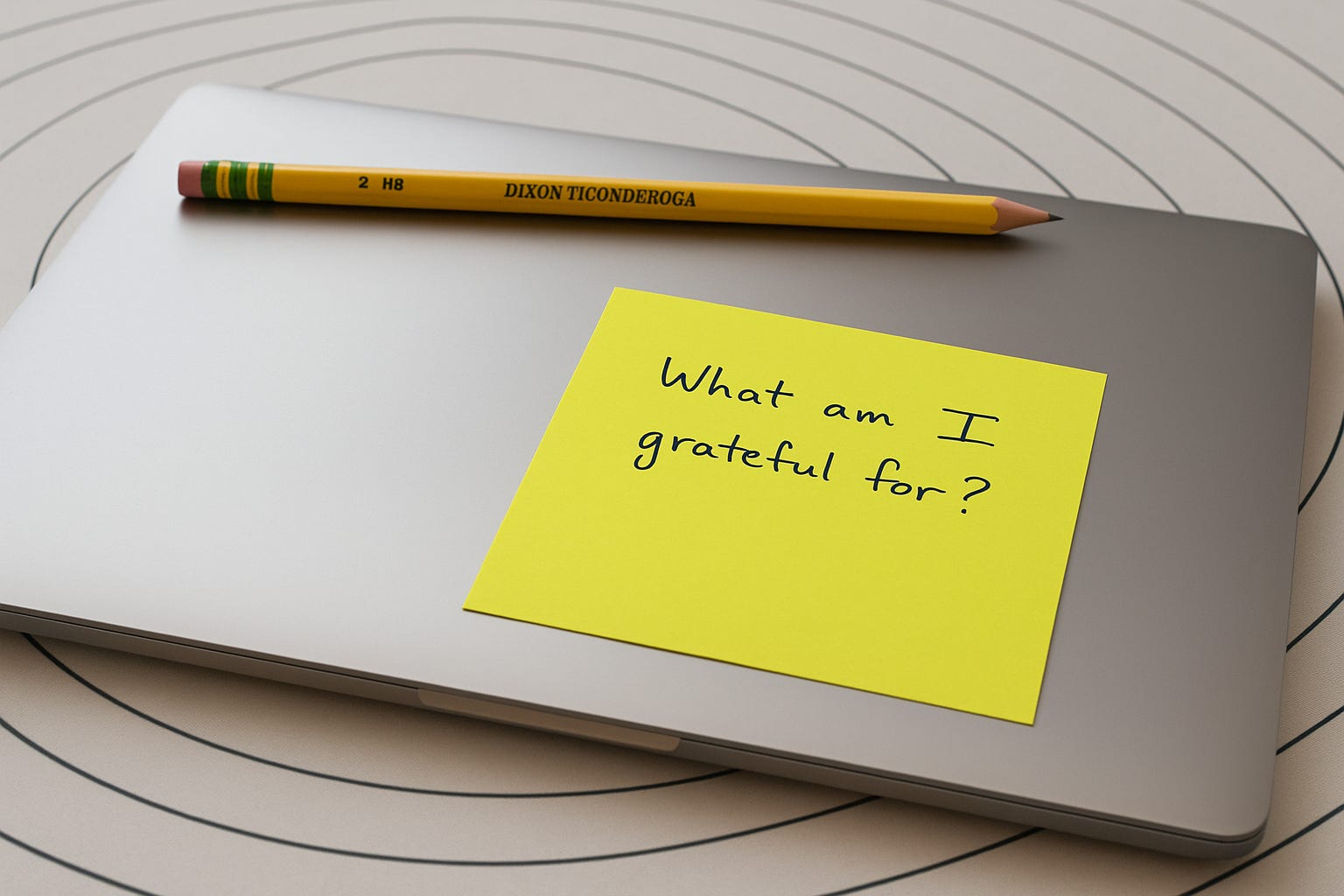
Whenever I come across a note or article that highlights the benefits of gratitude, I make a mental note to practice it more. For example, Satya Nadella often references his own morning habit of identifying something he’s thankful for—and the impact it has on his day.
Simple enough. Yet no matter how often I’m reminded of the value of gratitude—and try to start a practice—I struggle to make it stick. It’s an easy habit to let slip. Worse, I’ll sometimes pause for a moment of gratitude and still wonder whether I’ve really given it room to breathe.
Thankfully (see what I did there?) November gives us a built-in set of gratitude-related reminders. It’s a month full of prompts asking us to reflect on what we’re grateful for. You’re probably already making travel plans or preparing to take time off—so it’s a perfect moment to build in some time for a little personal reflection.
In his book The Book of Joy: Lasting Happiness in a Changing World, the Dalai Lama says: “It is not happiness that makes us grateful, it’s gratefulness that makes us happy.” There are a few takeaways in that insight.
An attention effect. Pausing to reflect on gratitude trains your attention, even briefly, to focus on what’s good and already present, rather than on problems or perceived threats.
A satisfaction effect. Gratitude reframes your experience of the present as a gift. This shift pulls you out of seeking mode, and makes you feel more content—even if nothing external has changed.
A people effect. Gratitude brings others to mind. You can’t help but think about those who’ve helped you, supported you, or mattered to you, and this, in turn, can spark feelings of connection. You might even be inspired to reach out, or pay it forward.
So what’s the ROI on a little gratitude? It turns out to be pretty measurable. There’s scientific evidence that a little gratitude can have quantifiable effects on your mental state.
First, it can boost well-being. In the classic randomized studies, “counting blessings” improved life satisfaction, optimism, and even some physical health markers compared to control groups. This was one of the first major studies on gratitude, and it’s still widely cited today. Since then, many follow-up studies have found the same basic thing: gratitude practices give a real but modest boost to mood and well-being.
Second, gratitude may actually change your brain. A 2015 Indiana University study involving a three-week gratitude letter exercise left participants with stronger, longer-lasting activity in the prefrontal cortex—that’s the part of the brain responsible for executive control and meaning-making. This change was still visible in the brain three months later.
Lastly, there is some evidence that being grateful can also improve your sleep. Feelings of gratitude have been shown to predict better sleep quality and duration, most likely because you end up having more positive pre-sleep thoughts and reduce rumination that can keep you awake.
Research also suggests that gratitude can increase life satisfaction, reduce depression, and even help make people more generous. That said, gratitude isn’t a cure-all. It’s just a low-cost tool that can make a meaningful difference.
What you can try today:
If you want to experiment with a dedicated way to reflect on what you’re grateful for, keep your practice light, simple, and consistent. Don’t overthink it.
The One-Sentence Version — available anytime. Just stop and say to yourself – “Today I’m grateful for ___ because ___.” That’s it.
SMS version. Now you’re introducing another human being into your practice. Text someone a 1-2 line message about what you’re thankful for today. This can create momentum and suddenly you’re lighting up your friends’ phones.
Public version: Share a thank you or even just a note about something you are grateful for in a meeting or Slack channel. It doesn’t have to be long – just real.
Weekly practice version: Experiment with a simple weekly practice. Sundays work for just thinking to yourself about three things you are grateful for that week. Easy. Repeatable. Helpful. You can even journal these in a notebook.
Since it’s November and the benefits of gratitude come at such a low cost relative to the return, give it a try. I will, too.
Here’s something I’m grateful for: You, reading this post to the very end. Thank you!
If you found this post helpful, forward this to someone who might need it.
One quote to end on
“I used to have a gratitude journal. At the end of the day, I’d write three things I was grateful for. But then, as I kept on doing it, over time, I realized during the day I’d be looking for things I’m grateful for – so I could write it at the end of the day.
So that way it keeps you in that frame of gratitude constantly through the day. Like, what am I going to write at the end of the day? What am I grateful for today? So you start flowing that vibe of gratitude, that vibration of gratitude. And when you vibe with gratitude, trust me abundance comes — it’s magic.”
— Israel Adesanya. Former Two-Time UFC Middleweight Champion (Link to Video)
Research cited:
Israel Adesanya quote (video) – finejoeflow
Tat Bellamy Walker, “Microsoft CEO Satya Nadella Uses This Simple Mindfulness Exercise to Improve Concentration Before Starting His Day,” Business Insider, June 10, 2020, (Link)
Dalai Lama, Desmond Tutu, and Douglas Carlton Abrams, The Book of Joy: Lasting Happiness in a Changing World, Amazon (product page), September 20, 2016, (Link)
Robert A. Emmons and Michael E. McCullough, “Counting Blessings versus Burdens: An Experimental Investigation of Gratitude and Subjective Well-Being in Daily Life,” Journal of Personality and Social Psychology 84, no. 2 (2003): 377–89, (Link)
Prathik Kini, Joel Wong, Sydney McInnis, Nicole Gabana, and Joshua W. Brown, “The Effects of Gratitude Expression on Neural Activity,” NeuroImage 128 (March 2016): 1–10, (Link)
Alex M. Wood, Stephen Joseph, Joanna Lloyd, and Samuel Atkins, “Gratitude Influences Sleep through the Mechanism of Pre-Sleep Cognitions,” Journal of Psychosomatic Research 66, no. 1
Geyze Diniz, Ligia Korkes, Luca Schiliró Tristão, Rosangela Pelegrini, Patrícia Lacerda Bellodi, and Wanderley Marques Bernardo, “The Effects of Gratitude Interventions: A Systematic Review and Meta-Analysis,” Einstein (São Paulo) 21 (July 31, 2023): eRW0371, (Link)
Sigal Samuel, “Giving Thanks May Make Your Brain More Altruistic,” Vox (Future Perfect), updated November 25, 2024. (Link)
If this helped you think more clearly about leading teams or products, I write here once a week.
Subscribe here.