

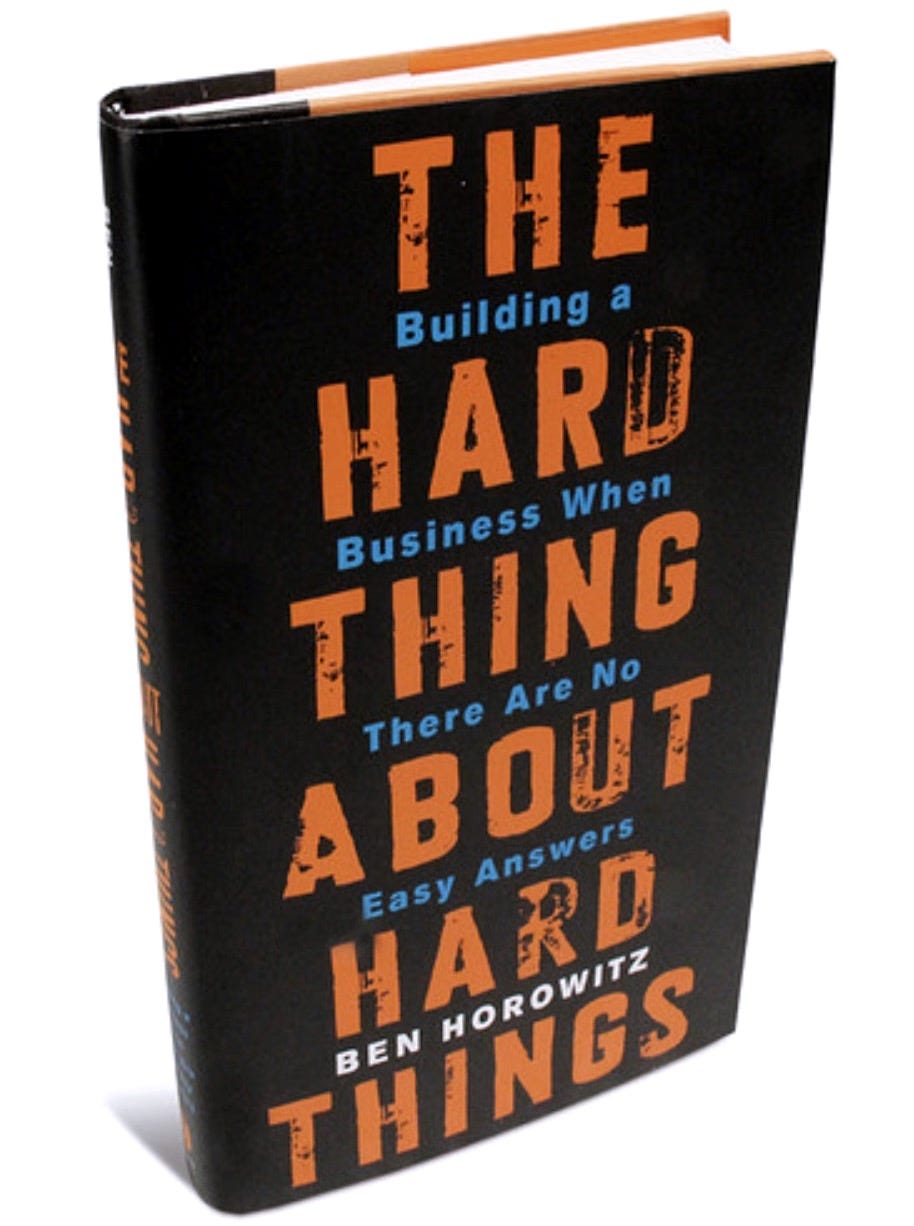
I wrote this post about 11 years ago on another blog and wanted to share it here because it’s relevant to a bunch of conversations I’ve been having lately with senior product leaders.
Book Review: “The Hard Thing About Hard Things.” (The book was originally published in March 2014, but I still highly recommend it.)
“Hard Things” is a fast read and is useful for anyone interested in learning about management, and more specifically, how Silicon Valley companies work. Note: it’s also the book home of one of my all-time favorite business quotes: “This is not checkers; this is motherfuckin’ chess.”
Horowitz’s idea was to write the management book that covers everything most management books never cover: the messy, hard stuff. Real stories from his time as CEO of Loudcloud, which later became Opsware, before it sold to Hewlett-Packard in 2007 for $1.6 billion.
Opsware was in trouble multiple times and in multiple ways from start to finish. In that sense it’s much more like how many companies work. Startups are usually hard, and most die. Not everything is up and to the right.
But my favorite, and in my mind the most useful part of the book, is actually infused throughout — it’s the drop-dead honest and simple way Horowitz has of communicating.
You get a sense for this when you read his take on specific stories or he quotes himself. But you also see it in between the stories in terms of how basic thoughts are conveyed.
TLDR: Be Simple. Use. As little. Words. As possible. Say exactly what you mean.
Take this example from the story about Horowitz trying to hire a VP of Sales into his struggling company. He has someone he thinks is fantastic in mind, but this person is apparently a little odd.
So board members plus Chairman and co-founder Mark Andreessen disagree and are arguing. The potential hire doesn’t look right. He went to a small school, and he has an off way about him. Horowitz listens and then simply says:
“I agree with every single one of those issues. However, Mark Cranney is a sales savant. He has mastered sales to a level that far exceeds anybody that I have ever known. If he didn’t have the things wrong with him that you enumerated, he wouldn’t be willing to join a company that just traded at thirty-five cents per share; he’d be the CEO of IBM.”
Boom. Simple. This candidate has some issues, but he is exactly what we need right now and oh by the way — let’s get real, we are not exactly playing from a position of strength. Imagine instead how that statement gets mangled by someone who is either not clear about exactly what he (or she) thinks or not willing to just state it:
“Hmmmmm. You have some good points, there. Really. You do. This guy has some positive points, but we’re all agreed we need the best possible hire. I guess I need to take another look at this situation with that in mind and report back to the board in 30 days.”
That statement there is a recipe for delay and then losing the candidate to top it off.
THAT, in the end, is the most valuable message of The Hard Thing About Hard Things. There are some useful, tactical lessons there to be sure. But really, the best lesson is about communicating with little wasted language or B.S.
This is not about being belligerent — just, well, straight. Take the time to know what you think and then say EXACTLY that. Doing so saves time and builds trust, both of which most startups are short on and desperately need.
Eleven years later, in conversations I’m having, the single most common thing I see show up is smart people who know exactly what they think and say the ‘Hmmmmm’ version, or no version at all.
Try the Mark Cranney story move one time this week. Take one moment in a context that matters, settle on what you actually think, then say EXACTLY that.
Let me know how it goes.
The gap between the Cranney version and the ‘Hmmmmm’ version is half of what I work on with coaching clients every week.
Hi, I’m Jeff. I spent 25 years building product at LinkedIn, Facebook, Headspace, and Included Health. Now I coach senior product leaders through the moments where the old playbook stops working: a bigger scope, a new company, communicating at the exec level, or figuring out what’s next. I work with a small number of 1:1 clients in six-month engagements, and every one started with a single conversation. If that’s you, or someone on your team — reply to this email. I read and answer every one.
Having been in a room with people who talk like those in the Horowitz example, I grow tired of the colorful, high stakes language. All his speech effectively said is "I believe in him, I know I can work with him, and I think he can do a lot for us. Are we going to get anyone better when we're trading at 35 cents a share?" Of those two statements, the second is probably more important. Best to keep everyone grounded, as you point out.