

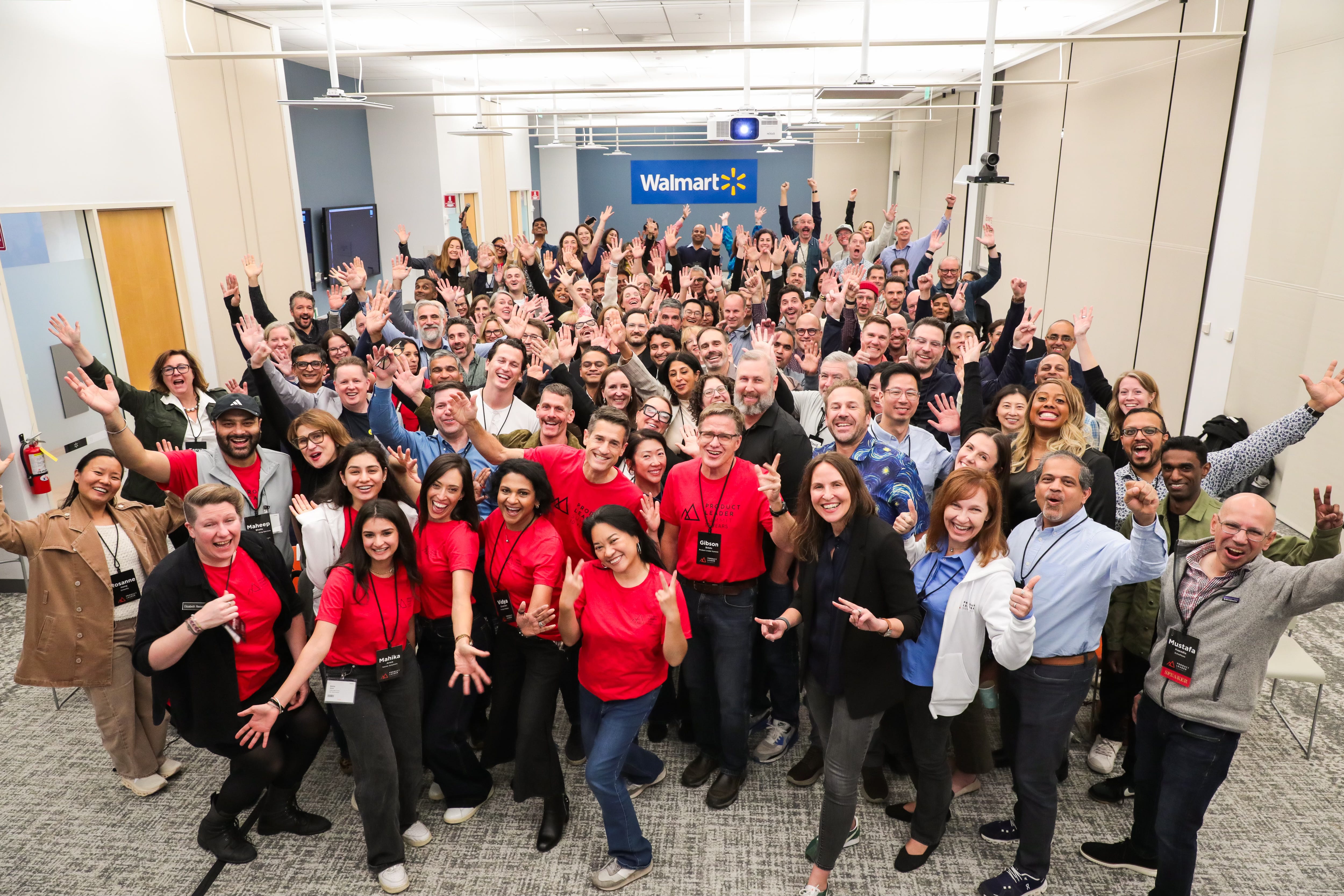
This week I was at Product Leader Summit at Walmart’s campus in San Bruno, California. This was 120 product leaders in town from all over the world for small group conversations and a slate of keynote talks. One throughline was real talk about how product and product leadership are evolving in the context of AI transformation. Here are a few notes and observations:
Overall vibe in the room: As AI transformation continues at an incredible pace, many leaders are seeing different realities on the ground. There was a lot of discussion about how long folks thought leaders and teams could keep up the current pace of technological and organizational change. There were also questions about hype and talk versus actual observed, scaled transformation. The clearest recurring theme was people seeing faster building without matching gains in product adoption or business outcomes.
Marty Cagan talk
Product leadership author, co-founder of Silicon Valley Product Group, and author of books like Inspired and Empowered.
Marty covered the evolving state of product management. He broke out different product roles showing up in different company operating models. His view, which I agree with, is that we tend to view change as affecting ‘product’ — but not all product roles are the same.
He described how he sees AI affecting each of these types of roles.
“Feature team product manager” – essentially project management: moving information and herding cats. Demand is declining here, even though there is some value in the role.
“Dedicated agile product owner” (this felt like a project or program manager to me): purely a delivery role – backlog management and sprint coordination. This role is being phased out rapidly because automation is accelerating.
“Empowered team product manager” (what I’d recognize from Facebook or LinkedIn, those kinds of companies): salaries here are growing fast as demand rises. The challenges of building with AI make this an even bigger and more challenging role because you’re talking about addressing marketability, compliance, privacy, quality, etc.
His message to product leaders: “Your number one job is to develop people who can do this.”
Another takeaway: Unicorn ICs who cover all three lenses (product, design, engineering) exist but don’t scale. He said he knows a few people who can do all three.
Link to text version of Marty’s talk.
Claire Vo talk
Founder of ChatPRD, a three-time chief product and technology officer, and host of the How I AI podcast.
Claire covered what she’s seeing and what can cause AI transformations to break. Building is now the easy part, so the blockers are now upstream (product strategy and discernment) and downstream (product adoption and real outcomes). Basically, teams can build faster but is it any good and does anyone care or use the thing?
She sees four failure zones: People, Ops, ROI, and Strategy.
For people, leaders have invested heavily in tools and tokens, but often not in org design thinking or culture change. So you may see experimentation with role blending, and shipping is faster, but a big recurring problem is that nobody owns the outcome. Claire’s view of the best answer is defining a DRI (directly responsible individual) at an initiative level, not determined by title.
In ops, the assumption that engineering is the scarce resource and must be protected at all costs is shifting quickly. She described a team whose PMs didn’t have enough ideas to keep pace with engineering. Adoption and go-to-market enablement also aren’t keeping pace. Here she suggested rethinking the way we do alphas and testing with limited customers to build things with the intention that some will be retired.
ROI: It’s measurable, but requires visibility into where tokens are going and what outcomes they produce, and not many have this. She suggested a cultural shift: build in public, treat work chat threads as enterprise data to connect token spend to outcomes.
Strategy: Infinite capacity can lead to a race to feature parity, not differentiation. We may be entering an era where leaders and product teams need to focus on creative ways to find compelling big ideas. Inspiration requires immersion in the world outside your own product. That means spending more time with customers and other products, rather than more time coding. She also urges teams to revisit ideas dismissed six months or a year earlier because now constraints have changed. Strategy must include restraint as well as ambition. What should NOT ship?
Quote that stayed with me:
“Not everything you ship should be considered a promise to your customers.”
Another takeaway: Claire described leaders spending $50M a year who can’t say exactly what that spending is producing.